
Blog
Terracotta Tealight Holders: Why Every Indian Home Needs at Least Three

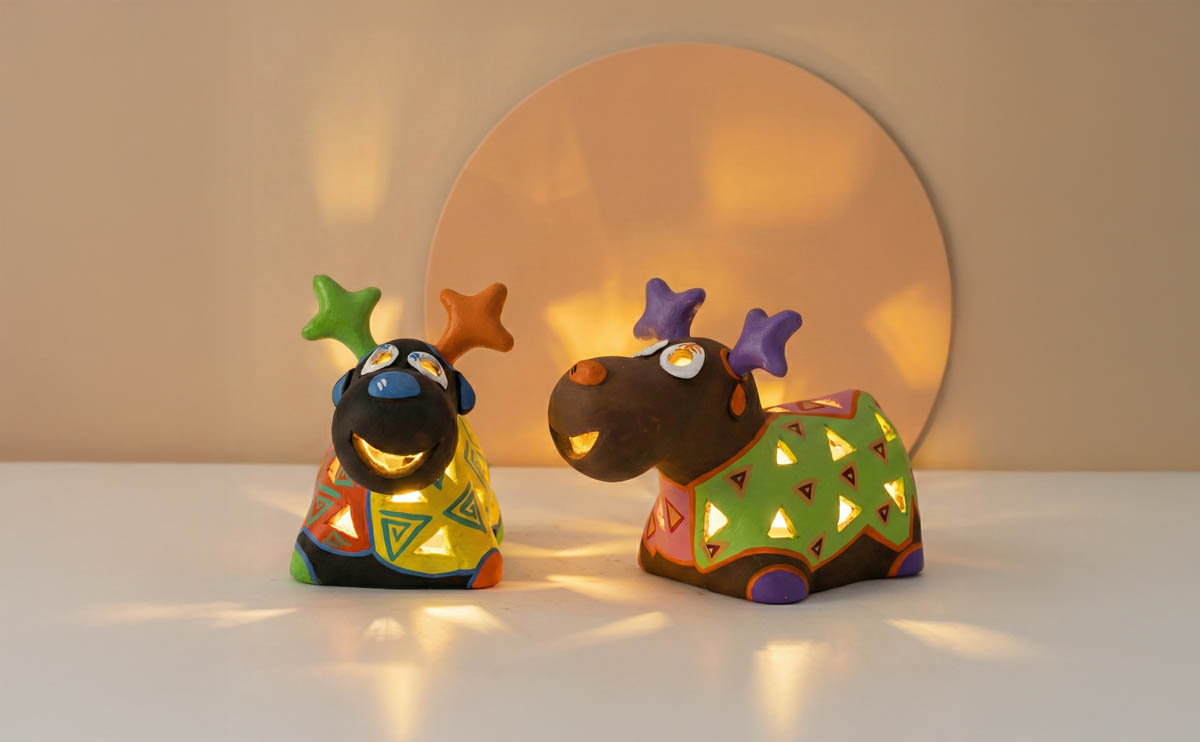
Three isn’t an arbitrary number. Three tealights on a dining table, grouped at slightly different heights, is the minimum viable lighting scene. Two looks like a date. One looks like a forgotten puja. Three is when a plain room starts to feel like a room someone lives in.
Terracotta tealight holders, specifically, change a room more than any other piece of small décor you can buy — because the light escapes through the cut-out patterns and throws shadows on the wall. A plain glass tealight gives you light. A hand-painted terracotta tealight gives you a shape on the wall behind it. That’s the whole trick.
Here’s how to buy and use them well.
What “good” looks like in a tealight holder
Three things separate a tealight holder that works from one that disappoints:
The clay wall should be thick enough to not burn. A good tealight holder stays cool enough to touch near the base even after 3–4 hours of burning. If it’s made from thin, under-fired clay, it gets uncomfortably hot and can crack.
The cut-outs should cast real shapes. Decorative patterns are either purely surface painting (boring) or pierced cut-outs (the light actually escapes through them). You want pierced. This is worth checking before buying — ask whether the design is painted-only or pierced.
The base should be flat and stable. Tealights move when you bump the table. If the holder wobbles, it’s not safe.
If the holder you’re looking at has hand-painted details plus pierced cut-outs plus a flat heavy base, you’ve found a good one.
Where they actually belong
Less obvious than you think.
Dining table. Three holders, all different sizes, clustered slightly off-centre (not in a line). Light them ten minutes before dinner, turn the main lights down one notch. Your weekday dal-chawal becomes an occasion.
Pooja shelf / mandir. Traditional Indian use-case. A terracotta holder with a diya inside feels more reverent than a metal one, for reasons you’d have to ask an architect or a grandmother to fully explain.
Bathroom. Unexpected. Put one on the counter, light it before a bath. The scale and the shape cast the room better than overhead lighting ever does.
Bedside. Not for sleeping with, but for the 20 minutes before bed. Light it, read, blow it out before you fall asleep.
Balcony. If there’s no breeze. A tealight holder with a guest or two outside, after sunset, with the city noise — very specific mood, achievable for ₹400.
Where not to: directly under curtains, on unstable surfaces, anywhere kids or pets will knock them, and near anything that burns.
The three-holder setup (our recommendation)
The cheapest way to dramatically change a dining or living room. Mix the sizes.
- One large terracotta tealight holder (8–10cm tall) with intricate pierced work — the “hero” of the group. This is the one that throws the most dramatic shadows.
- One medium holder (6–7cm), with simpler or contrasting motifs. It balances the large one.
- One small holder (4–5cm), plain or single-motif. Grounds the group.
Cluster them with a little asymmetry. Not evenly spaced. The eye likes the slight randomness.
Total cost: typically ₹800–1,400 for a well-made hand-painted set.
Tealight vs. diya — they’re not the same thing
Worth clarifying, because Indian customers ask this.
- Tealight: a small paraffin or soy wax candle in a metal cup, burns 3–4 hours. Pre-made, disposable cup.
- Diya: traditional oil lamp, usually ghee or mustard oil with a cotton wick. Can be lit any time, refillable, burns as long as you want.
Terracotta tealight holders are designed for the small metal-cup tealights. A terracotta diya is a different piece — shallower, open, with a lip for the wick.
Some terracotta holders work for either. If you want one piece for both, buy a holder with a wider opening (4–5cm across) that can fit either a tealight cup or a diya.
The lighting math, briefly
If you’re furnishing a room with warmth in mind, tealight holders are dramatically efficient. A 75-watt warm bulb overhead costs more to run than you think. Three tealights — negligible cost, genuine atmosphere — deliver a specific mood that the bulb literally cannot.
This is why a restaurant you’ve been to that you remember as “cosy” almost always used candles. It’s not nostalgia. It’s that human eyes read flickering warm light as intimacy in a way steady electric light can’t duplicate.
Caring for terracotta tealight holders
Not much to do, but a few things worth knowing.
• Keep them dry after use — terracotta loves to breathe, not soak.
• Wipe gently with a soft dry or slightly damp cloth.
• Avoid harsh chemicals or scrubbing.
• Wash them directly with running water.
• While lighting a tealight, place it on a flat surface away from strong wind.
• Let the holder cool down before touching or cleaning.
• Small natural marks or colour variations are part of handmade terracotta beauty
What they’re worth
A well-made hand-painted terracotta tealight holder is one of the highest atmosphere-to-cost ratios in home décor. Genuinely. A good set of three changes how a room feels at night for ₹800–1,400 — a fraction of what you’d spend on a lamp that does less for the mood.
They’re also a near-universal gift. Housewarming, Diwali, birthdays for anyone over 25 with a house. Hard to get wrong.
Explore Pipihiri’s hand-painted terracotta tealight holders — each piece pierced by hand and fired in small batches. Use code THREESOME at checkout if you’re ordering three or more.